
In distributed cloud architectures, messaging services are the backbone of asynchronous communication between decoupled components. Amazon Web Services (AWS) provides two critical messaging services that are fundamental to building scalable, event-driven systems: AWS SQS and AWS SNS. While both enable asynchronous messaging, they follow fundamentally different architectural patterns and serve distinct purposes.
Understanding the differences between AWS SQS vs SNS is essential for cloud architects and DevOps engineers designing robust infrastructure. This guide provides an in-depth comparison of both services, their core capabilities, real-world use cases, and how to leverage them effectively—either independently or together—in modern cloud architectures.
What Is Message Queuing and Pub/Sub?
Message-based communication enables systems to exchange information asynchronously without requiring direct connections or synchronous calls. Two primary messaging patterns emerged in distributed computing: message queuing and publish-subscribe (pub/sub).
Message Queuing follows a point-to-point model where messages are placed in a queue and retrieved by a single consumer. This pattern decouples producers from consumers, allowing components to operate at different speeds and handle temporary outages gracefully.
Publish-Subscribe implements a broadcast model where a publisher sends messages to a topic, and multiple subscribers receive those messages simultaneously. This pattern is ideal for event notification and fan-out scenarios where one event triggers multiple workflows.
Both patterns are essential for building resilient systems. Choosing between them depends on your architectural requirements and use cases.
What Is AWS SQS?
Amazon Simple Queue Service (SQS) is a fully managed message queuing service that stores messages durably until they are consumed by workers or applications. SQS provides reliable, scalable infrastructure for asynchronous processing without requiring infrastructure management.
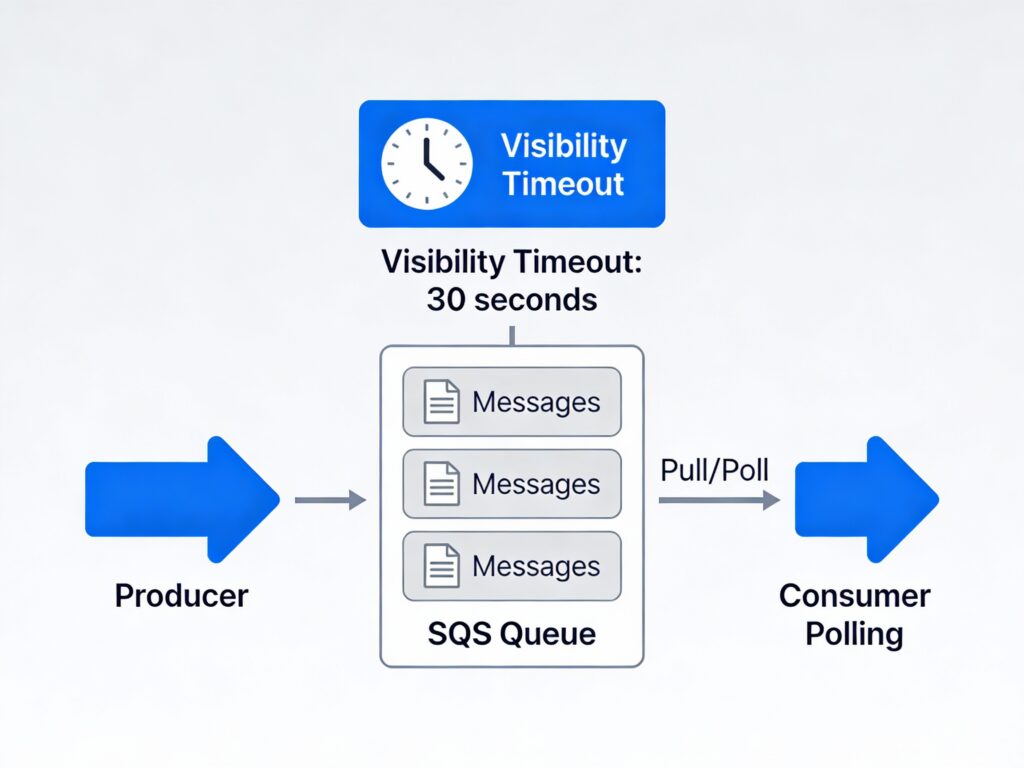
SQS operates on a pull-based (polling) model. Consumers explicitly request messages from the queue, giving them control over processing pace and enabling batch processing of messages. Messages remain in the queue until a consumer successfully processes and explicitly deletes them.
SQS excels at decoupling application components, enabling background job processing, distributing workloads across multiple workers, and providing durable message buffering during traffic spikes. It’s ideal for scenarios where reliable delivery, processing control, and message persistence are critical.
Key Features of AWS SQS
- Two Queue Types: Standard queues offer unlimited throughput with best-effort ordering; FIFO (First-In-First-Out) queues guarantee strict ordering and exactly-once processing at 300 messages per second (3,000 with batching).
- Message Durability: Messages persist for 1 minute to 14 days, ensuring no data loss during processing delays or consumer outages.
- Visibility Timeout: When consumers retrieve messages, they become invisible to other consumers for a configurable duration, preventing duplicate processing during failures.
- Dead-Letter Queues (DLQs): Failed messages automatically move to a DLQ after exceeding maximum receive attempts, enabling error investigation and handling.
- At-Least-Once Delivery (Standard): Standard queues guarantee each message is delivered at least once; FIFO queues guarantee exactly-once processing with no duplicates.
What Is AWS SNS?
Amazon Simple Notification Service (SNS) is a fully managed pub/sub messaging service designed for rapid message distribution to multiple endpoints simultaneously. SNS excels at broadcasting notifications to diverse subscriber types with minimal latency.
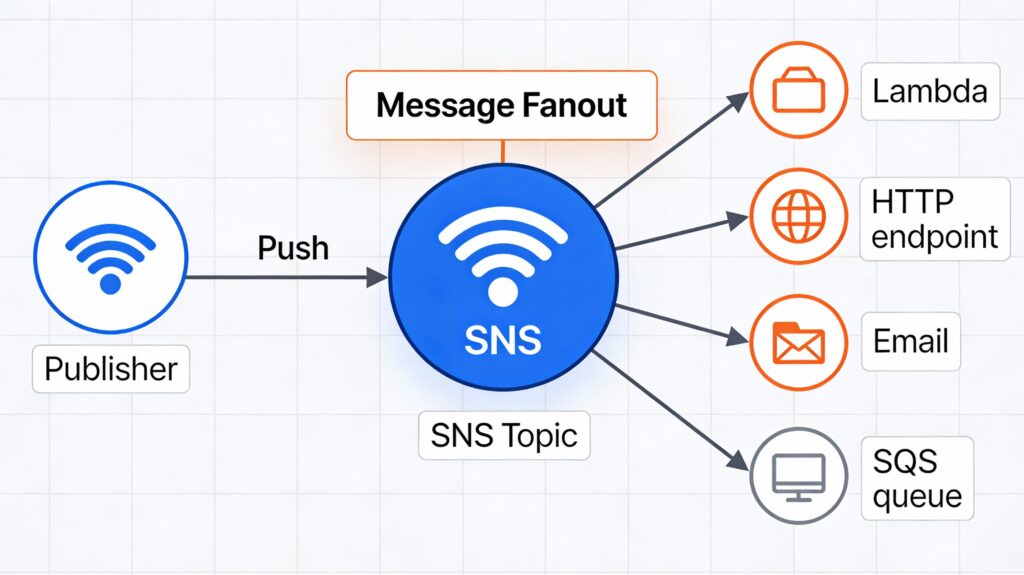
SNS follows a push-based model. When messages are published to a topic, SNS immediately pushes them to all subscribed endpoints—Lambda functions, HTTP/S endpoints, SQS queues, email, SMS, and mobile push notifications—without requiring subscribers to poll for updates.
SNS is purpose-built for event-driven architectures, real-time notifications, system alerts, and fan-out messaging patterns where a single event must trigger multiple independent workflows.
Key Features of AWS SNS
- Multiple Protocols: Supports Application-to-Application (A2A) communication via Lambda, SQS, HTTP/S and Application-to-Person (A2P) via email, SMS, and mobile push notifications.
- Topic-Based Organization: Publishers send messages to topics; subscribers receive messages based on their interests, enabling flexible message distribution.
- Message Filtering: Subscribers can filter messages by attributes, ensuring they receive only relevant notifications and reducing processing overhead.
- Fan-Out Capability: One published message automatically reaches thousands of subscribers in parallel, enabling massive scale with a single publish operation.
- Delivery Retries: SNS implements a sophisticated retry policy with exponential backoff, attempting message delivery up to 100,000 times over 23 days before giving up.
AWS SQS vs SNS — Quick Comparison
| Feature | AWS SQS | AWS SNS |
|---|---|---|
| Messaging Model | Queue-based (point-to-point) | Topic-based (publish-subscribe) |
| Delivery Mechanism | Pull-based (consumers poll) | Push-based (automatic delivery) |
| Message Persistence | 1 minute to 14 days | No persistence; delivered immediately |
| Fan-Out Support | Limited; one message per consumer | Native support; one message to many subscribers |
| Ordering & Duplicates | Standard: best-effort; FIFO: strict order, no duplicates | Best-effort delivery; no ordering guarantee |
| Consumer Control | High; consumers control processing pace | Limited; SNS pushes immediately to subscribers |
| Typical Use Cases | Background jobs, task queues, workload distribution | Notifications, event triggers, real-time alerts |
| Subscription Types | Queues only | Lambda, HTTP/S, Email, SMS, SQS, mobile push |
| Delivery Guarantee | At-least-once (Standard) or exactly-once (FIFO) | Best-effort with retry policy |
| Scalability | Scales with message volume | Scales with subscriber count |
Key Differences Between AWS SQS and SNS
Architecture and Communication Model
AWS SQS implements a decoupled queue architecture. Producers place messages into a queue without knowing who will consume them. Multiple consumers can poll the same queue, but each message is processed by only one consumer. This one-to-one consumption model ensures that work is distributed among consumers without duplication (in FIFO mode) or reliably despite occasional duplication (in Standard mode).
AWS SNS implements a fan-out architecture. Publishers send messages to topics without knowing subscribers’ identities. SNS automatically delivers each message to all current subscribers simultaneously. Multiple subscribers can process the same message independently, enabling parallel workflows and reducing coupling between systems.
The architectural difference profoundly affects scalability. SQS scales with message volume—the number of messages in the queue. SNS scales with subscriber count—each added subscriber doesn’t impact performance significantly.
Message Delivery and Consumption
Delivery Model represents the most fundamental difference. SQS’s pull-based model gives consumers complete control. Consumers retrieve messages when ready, enabling batch processing, rate limiting, and sophisticated error handling. This approach introduces slight latency—the time between message arrival and consumer polling—but provides reliability and control.
SNS’s push-based model delivers messages immediately to subscribers with millisecond latency. However, subscribers have limited control over delivery timing and may face overwhelming message rates during traffic spikes.
Message Retention differs significantly. SQS stores messages durably for extended periods (configurable 1 minute to 14 days), enabling consumers to process messages at their own pace or retry after failures. SNS doesn’t persist messages—it delivers them immediately to available subscribers, then discards them. If subscribers are unavailable, SNS retries based on its retry policy but doesn’t permanently store messages.
Ordering, Durability, and Reliability
SQS Standard Queues provide best-effort ordering and at-least-once delivery. Messages generally arrive in order but may occasionally be delivered out of sequence due to SQS’s distributed architecture. Duplicates can occur, requiring idempotent consumers.
SQS FIFO Queues guarantee strict first-in-first-out ordering and exactly-once processing with no duplicates. However, throughput is limited to 300 messages per second (3,000 with batching).
AWS SNS provides best-effort delivery without ordering guarantees. Standard topics offer high throughput with best-effort ordering; FIFO topics guarantee ordering but only support SQS FIFO queue subscriptions. SNS retries failed deliveries extensively but doesn’t guarantee delivery—if all retry attempts fail, the message is lost.
Durability heavily favors SQS. Messages in SQS persist indefinitely (up to 14 days) until successfully processed. Dead-Letter Queues capture failed messages for investigation. SNS offers no such persistence—failed messages are eventually discarded.
Scalability and Performance
AWS SQS scales automatically with message volume. Standard queues support virtually unlimited throughput (up to 20,000 messages per second per partition). FIFO queues provide 300 messages per second standard throughput (3,000 with batching). Consumers scale independently based on queue depth and processing capacity.
AWS SNS scales with subscriber count. Adding subscribers doesn’t degrade performance; SNS efficiently manages deliveries to thousands of endpoints simultaneously. Throughput to individual subscribers may vary based on their processing capacity.
Latency differs significantly. SQS introduces polling latency—the delay between message arrival and consumer polling (typically hundreds of milliseconds). SNS delivers messages in milliseconds, making it ideal for real-time use cases.
Cost and Pricing Considerations
Both services charge per API request. SQS pricing scales with message volume—higher throughput incurs higher costs. SNS pricing scales with message volume and delivery protocol. Delivering to diverse endpoints (email, SMS, mobile push) costs more than Lambda or SQS subscriptions.
For high-fan-out scenarios (one event triggering many processes), combining SNS and SQS is often more cost-effective than individual SQS queues. SNS fans out one message to multiple SQS queues economically; consumers scale independently without API request overhead.
When to Use AWS SQS
Choose AWS SQS when you need reliable, durable message processing with consumer control:
- Background Job Processing: Offload time-consuming tasks (image processing, report generation, data imports) to worker pools without blocking user requests.
- Task Queues and Microservice Decoupling: Decouple microservices enabling independent scaling and deployment without direct service-to-service communication.
- Workload Leveling: Buffer incoming requests during traffic spikes, processing them gradually as workers become available.
- Batch Processing: Accumulate messages and process in batches for efficiency (database bulk inserts, bulk API operations).
- Retry and Error Handling: Leverage visibility timeouts and DLQs for sophisticated error recovery and investigation.
- Exactly-Once Processing Requirements: Use FIFO queues for financial transactions, order processing, or systems where duplicates are unacceptable.
When to Use AWS SNS
Choose AWS SNS when you need rapid, multi-endpoint message distribution:
- Real-Time Event Notifications: Broadcast system events (deployments, security alerts, infrastructure changes) to multiple recipients instantly.
- Fan-Out Messaging: Trigger multiple independent workflows from a single event (user registration initiating welcome email, profile creation, analytics logging).
- Multi-Channel Alerts: Send urgent notifications simultaneously via email, SMS, and in-app notifications without managing individual channels.
- Event-Driven Architectures: Implement loosely coupled event flows where publishers don’t need to know about subscribers.
- Application-to-Person Communication: Send user notifications, promotional messages, or transactional alerts via email, SMS, or mobile push.
- Scaling to Many Subscribers: Handle one-to-many messaging at any scale (thousands of subscribers) without performance degradation.
Using AWS SQS and SNS Together
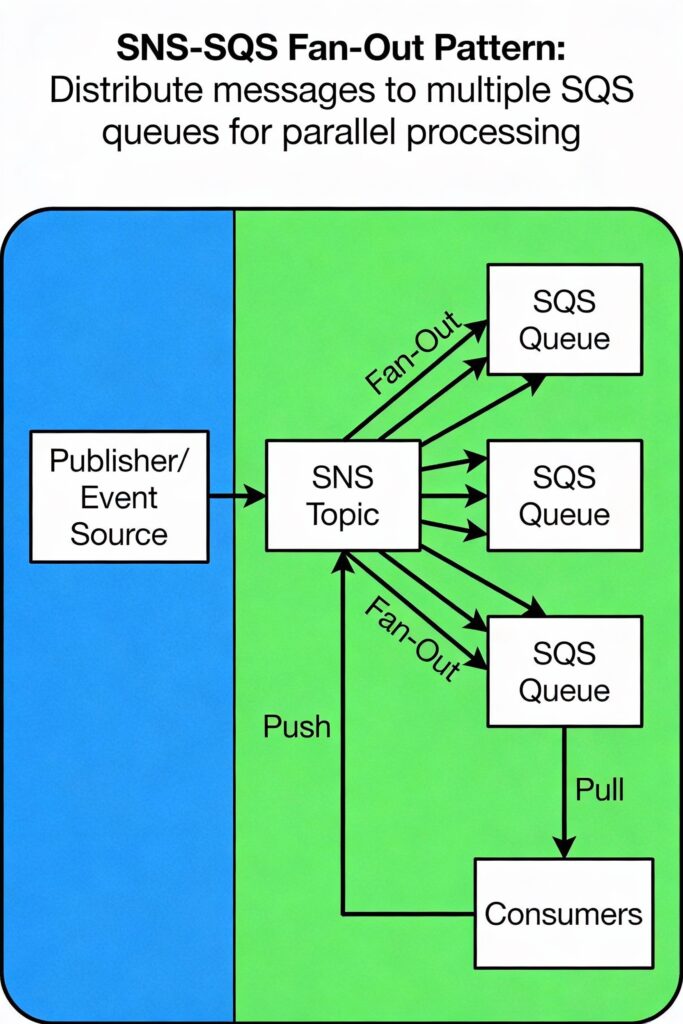
The most powerful messaging architecture combines both services using the SNS-to-SQS fan-out pattern. This pattern leverages SNS’s efficient broadcast capabilities with SQS’s durability and processing control.
How It Works:
- Publishers send events to an SNS topic
- Multiple SQS queues subscribe to that topic
- SNS automatically delivers event copies to each queue
- Each downstream system processes messages from its dedicated queue independently
- Different systems scale autonomously without interference
Real-World Example: E-Commerce Order Processing
When a customer places an order, the system publishes an “OrderPlaced” event to an SNS topic. Three independent services subscribe:
- Payment Service Queue: Processes payments and captures transaction details
- Inventory Service Queue: Updates stock levels and triggers restocking workflows
- Notification Service Queue: Sends order confirmation emails and SMS updates
Each service processes its queue at its own pace. If the payment service is temporarily slow, it doesn’t delay inventory updates or customer notifications. Failed messages move to respective DLQs for investigation without affecting other systems.
Benefits of SNS-SQS Integration:
- Fan-Out with Durability: SNS efficiently distributes to multiple queues; SQS ensures no message loss
- Independent Scaling: Each consumer scales based on its queue depth without affecting others
- Decoupling: Publishers don’t know about subscribers; systems evolve independently
- Resilience: Failures in one service don’t impact others; DLQs enable debugging
- Cost Efficiency: SNS fan-out to multiple SQS queues is cheaper than alternative architectures
Pros and Cons of AWS SQS
Advantages of AWS SQS
- Message Durability: Messages persist for up to 14 days, ensuring reliable processing even during extended outages
- Exactly-Once Processing: FIFO queues eliminate duplicates; idempotency is unnecessary
- Dead-Letter Queues: Automatic error isolation and investigation without clogging main queues
- Consumer Control: Consumers control processing pace, enabling batch operations and rate limiting
- Visibility Timeout: Prevents duplicate processing if consumers fail before completing work
- Cost Effective: Standard queues offer unlimited throughput; ideal for high-volume scenarios
- Simple Integration: Native AWS Lambda integration, CloudWatch monitoring, and IAM policies
- Batch Operations: Retrieve and process up to 10 messages per API call, reducing overhead
Disadvantages of AWS SQS
- Polling Latency: Consumers must poll regularly; messages experience delay before processing
- Best-Effort Ordering (Standard): Message order isn’t guaranteed; applications must handle out-of-order processing
- No Fan-Out Natively: Single message reaches one consumer; fan-out requires external coordination
- Complexity at Scale: Managing message visibility timeouts, DLQ configurations, and consumer scaling adds operational overhead
- FIFO Limitations: Lower throughput (300 TPS); not suitable for high-volume applications
- No Multi-Protocol Delivery: Messages only reach SQS queues; external notifications require separate services
Pros and Cons of AWS SNS
Advantages of AWS SNS
- Real-Time Delivery: Messages reach subscribers in milliseconds; ideal for time-sensitive notifications
- Native Fan-Out: Broadcast one message to thousands of subscribers efficiently without application code
- Multi-Protocol Support: Deliver via Lambda, HTTP/S, email, SMS, and mobile push from single topic
- Message Filtering: Subscribers filter by attributes, reducing unwanted message processing
- Automatic Retries: Sophisticated retry policy with exponential backoff handles temporary failures
- Event-Driven Simplicity: Publishers don’t manage subscribers; systems remain loosely coupled
- Massive Scale: Deliver to any number of subscribers without performance degradation
- Cost Efficiency: Single publish fans out to many endpoints; economical for broad distribution
Disadvantages of AWS SNS
- No Message Persistence: Messages vanish after delivery attempts; no durability for processing control
- Best-Effort Delivery: Not guaranteed—messages can be lost if all retries fail (though rare)
- Limited Consumer Control: Push model doesn’t allow consumers to control processing pace
- No Ordering Guarantees: Standard topics don’t preserve message order (FIFO topics have restrictions)
- Subscriber Overload: No back-pressure; rapid message flow can overwhelm slow subscribers
- Protocol Limitations: Some protocols (email, SMS) have delivery guarantees weaker than others
- No Batch Consumption: Subscribers receive messages individually; batch processing requires external coordination
- Retry Complexity: Custom retry logic requires HTTP/S delivery policies; other protocols use defaults
Conclusion
AWS SQS vs SNS represents a choice between two complementary messaging patterns rather than competing services. AWS SQS excels at durable, controlled message processing—ideal for background jobs, task queues, and scenarios requiring exactly-once processing and consumer control. AWS SNS excels at rapid, multi-endpoint message distribution—ideal for real-time notifications, event broadcasting, and fan-out architectures.
The optimal strategy for most modern applications combines both services. Use SNS to broadcast events efficiently and SQS to ensure reliable processing with consumer control and durability. This SNS-to-SQS fan-out pattern decouples systems, enables independent scaling, and provides resilience.
When designing event-driven architectures, ask yourself: Do you need multiple recipients processing the same message? Use SNS (or SNS + SQS). Do you need durable, reliable processing of individual work items? Use SQS. For comprehensive event-driven systems handling both concerns, implement the fan-out pattern leveraging both services.
FAQ: AWS SQS vs SNS
The fundamental difference is the delivery model. AWS SQS uses pull-based (polling) message delivery—consumers request messages from queues and process them at their own pace. AWS SNS uses push-based delivery—automatically distributing messages to subscribers immediately. In AWS SQS vs SNS comparisons, SQS is for durable message queuing, SNS is for real-time fan-out notifications.
Yes, absolutely. The SNS-to-SQS fan-out pattern combines both services effectively. SNS topics publish events to multiple subscribed SQS queues, enabling each queue to feed independent consumers. This pattern provides SNS’s efficient broadcasting with SQS’s message durability and consumer control. AWS SQS vs SNS together create powerful event-driven architectures.
Exactly. AWS SQS is pull-based—consumers actively retrieve messages by polling the queue. AWS SNS is push-based—automatically delivers messages to subscribers without requiring them to request messages. This architectural difference affects latency, processing control, and scalability between AWS SQS vs SNS.
Both serve microservices well but differently. Use AWS SQS for task-oriented communication between services (background processing, job distribution). Use AWS SNS for event-driven communication where one service event triggers multiple downstream services. Often, AWS SQS vs SNS decision depends on whether you need one-to-one or one-to-many communication patterns.
AWS SNS provides best-effort delivery with extensive retries (up to 100,000 attempts over 23 days for AWS endpoints). However, it doesn’t guarantee delivery—if all retries fail, messages are lost. For guaranteed delivery, use AWS SQS. The AWS SQS vs SNS trade-off is latency (SNS faster) versus reliability (SQS guaranteed).
This question mixes concepts. AWS SNS handles message distribution. If you’re asking whether SNS handles application configuration management like configuration management tools, the answer is no. SNS is a messaging service, not a configuration manager. For AWS SQS vs SNS decision-making, focus on messaging needs, not configuration management.
Comments