
For more than a decade, hybrid cloud has been pitched as the “best of both worlds”—a way for enterprises to keep sensitive data on-premises while tapping into the elasticity and innovation of public cloud platforms. But in 2025, hybrid cloud is no longer a compromise model or a stepping stone to full cloud migration. It has become the default operating architecture for large enterprises, AI-driven organizations, and companies navigating tightening regulations.
Yet hybrid cloud is not a magic formula. Behind the glossy marketing are real engineering trade-offs—some that save millions, and others that quietly accumulate cost and complexity. After 30+ years in the trenches of enterprise infrastructure, cloud modernization, and on-prem systems, I’ve seen hybrid cloud succeed brilliantly—and fail spectacularly—depending on how well organizations understand its true advantages and disadvantages.
As hybrid cloud architectures mature, leading hybrid cloud providers are increasingly focusing on interoperability, security, and AI-ready infrastructure to support enterprise demands.
Why Hybrid Cloud Became the Enterprise Standard
The logic behind hybrid cloud used to be simple: move what you can to the cloud, retain what you must in your data center. But in recent years, deeper forces have pushed organizations toward hybrid architectures:
- AI workloads with massive data gravity
- Global data sovereignty regulations
- Increased cloud repatriation due to costs
- Distributed workforce and edge computing growth
- Multicloud service diversification
According to Flexera’s 2024 Cloud Report, 82% of enterprises now operate in a hybrid model, and Gartner expects hybrid strategies to dominate enterprise IT roadmaps well beyond 2027. The shift is not about resisting cloud adoption—it’s about building modern infrastructure without sacrificing control, performance, or economic predictability.
To understand hybrid cloud’s momentum, we must examine its benefits and its trade-offs with equal honesty.
The Advantages of Hybrid Cloud
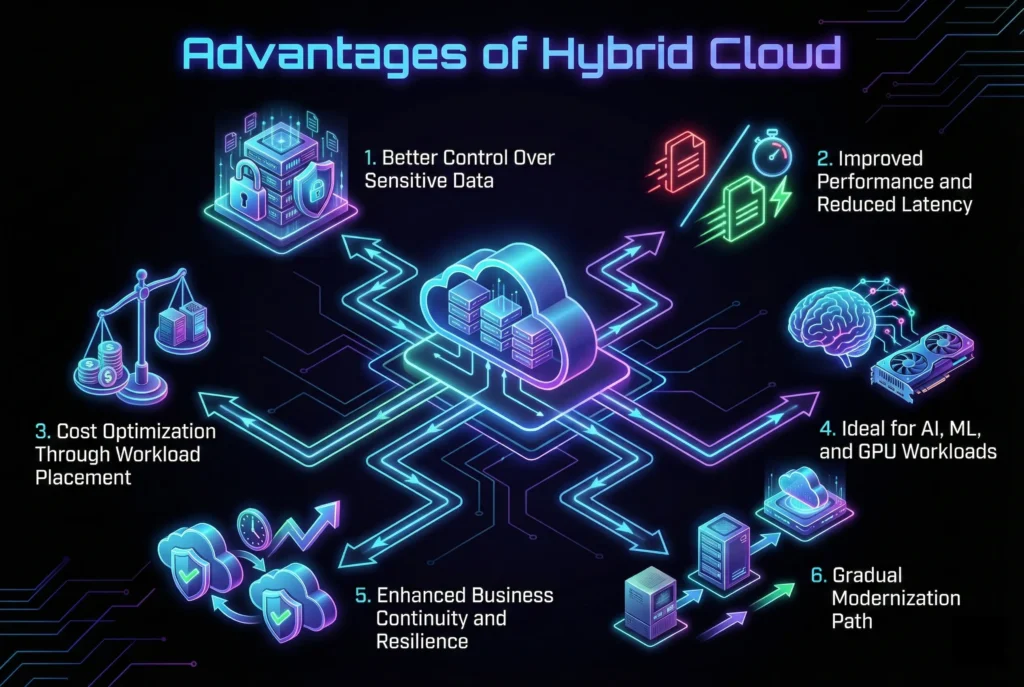
Hybrid cloud’s appeal lies in its balance. It’s not fully cloud, not fully on-prem—it’s the architectural middle ground where performance, governance, and innovation can coexist. But the advantages run deeper than simple flexibility.
1. Greater Control of Sensitive Data and Compliance Needs
For industries bound by strict regulations—finance, healthcare, government, aerospace—the notion of pushing all data to the cloud is unrealistic. Sensitive workloads often require:
- Physical data residency within specific regions
- Dedicated access controls not always available in cloud environments
- Low-level auditability for compliance frameworks
Hybrid cloud lets organizations retain full control over sensitive datasets in their own environments while still using the public cloud for analytics, development, or customer-facing services.
This is not just convenient—it’s often legally mandatory.
2. Better Performance Through Locality and Reduced Latency
Latency remains the hardest problem in cloud computing. No matter how advanced cloud networking becomes, physical distance cannot be eliminated.
Hybrid architectures give companies the option to run latency-sensitive applications—like transaction engines, real-time monitoring systems, AR/VR platforms, or AI inferencing—closer to users or machines. Meanwhile, batch workloads or burst compute can run in the cloud.
In sectors like retail, manufacturing, and telecom, hybrid cloud is not an optimization—it’s a necessity.
3. Cost Efficiency for Predictable vs. Elastic Workloads
Public cloud is excellent for elastic scaling but notoriously expensive for predictable, always-on workloads. Enterprises that migrated entirely to cloud often experience sticker shock when consistent workloads consume high-cost instances 24/7.
Hybrid cloud allows organizations to:
- Keep long-running workloads on on-prem hardware they already own or optimize
- Burst into the cloud only when demand spikes
- Avoid runaway cloud bills caused by inefficient resource usage
This is one reason behind the trend known as cloud repatriation, where companies bring workloads back from the cloud to reduce operational costs. A 2023 VMware study found that 33% of organizations had already repatriated major workloads.
Hybrid cloud provides the balance that full cloud migrations lacked.
4. Essential for AI, ML, and GPU-Driven Workflows
AI has quietly become the biggest driver of hybrid adoption.
Training models requires enormous datasets—with sizes that make constant cloud transfer economically and technically impractical. Many organizations maintain:
- On-prem GPU clusters for training
- Cloud GPU fleets for burst capacity
- Local storage for data gravity
AI workloads also require rapid iteration and low-latency access to proprietary datasets. Hybrid cloud solves this by anchoring data locally while allowing model experimentation in the cloud.
In 2025, every serious AI organization—from manufacturing to biotech—relies on some form of hybrid infrastructure.
5. Operational Resilience and Business Continuity
By distributing workloads across on-prem and cloud environments, hybrid cloud inherently improves resilience.
If a region outage affects a cloud provider (and they do happen), on-prem systems can continue running. Similarly, if a data center experiences downtime, cloud replicas can take over.
This dual-infrastructure strategy creates natural redundancy, something pure cloud or pure on-prem environments struggle to achieve.
The Disadvantages of Hybrid Cloud
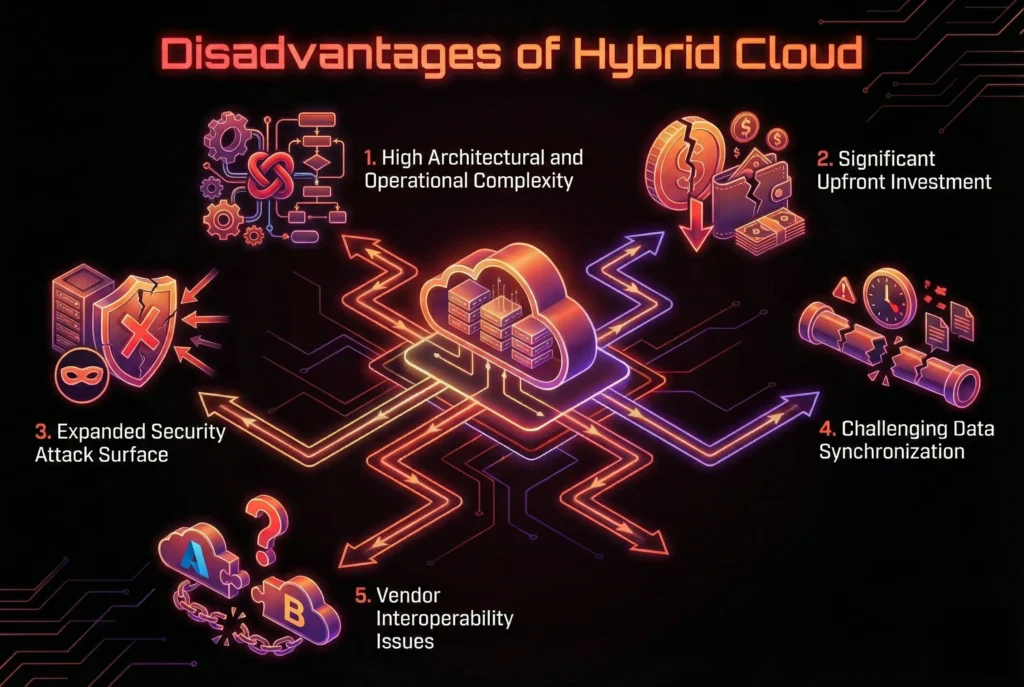
Hybrid cloud’s strengths are real, but they come with equally real challenges—many of which are underestimated during planning.
1. Complexity That Grows Faster Than Capabilities
Hybrid cloud is not one system—it is two or more systems stitched together.
Every additional environment increases complexity in:
- Identity management
- Networking and routing
- Monitoring and observability
- Logging and SIEM integration
- Access control
- Compliance reporting
- API compatibility
This complexity is not just architectural—it affects hiring, tooling, and operations. Organizations that underestimate this can end up with fragile infrastructure that’s hard to scale or troubleshoot.
2. Higher Upfront Investment to Make Hybrid Work
Despite the perception that cloud reduces CapEx, hybrid cloud requires significant upfront spending:
- Direct Connect / ExpressRoute lines
- Private cloud infrastructure (VMware, Nutanix, OpenStack)
- Replication hardware
- Redundant networking systems
- Backup and DR appliances
This makes hybrid cloud more expensive at the start compared to a pure cloud migration. The payoff comes later, through operational efficiency and long-term savings—but the barrier to entry is undeniably higher.
3. Expanding Security Surface and More Attack Vectors
Hybrid cloud blends the risks of two environments:
- Cloud misconfigurations
- On-prem vulnerabilities
- Identity drift
- Privilege escalation across environments
- Shadow IT between cloud and local applications
Security teams suddenly have to master cloud-native security, traditional data center security, and the glue between them.
A hybrid system is often only as secure as the least maintained environment.
4. Data Synchronization and Transfer Bottlenecks
Moving data between cloud and on-prem environments is often harder than it appears on diagrams.
Challenges include:
- Egress fees that quietly inflate costs
- Bandwidth bottlenecks for large datasets
- Data consistency issues across distributed systems
- Latency during replication
- Full dataset transfers that can overwhelm networks
For data-heavy organizations, poorly planned hybrid architectures can become networking nightmares.
5. Vendor Interoperability Issues
Every cloud provider promotes hybrid solutions—AWS Outposts, Azure Arc, Google Anthos, Oracle Cloud@Customer—but none of them are naturally interoperable.
Organizations often face:
- Differing API behaviors
- Misaligned identity frameworks
- Conflicting monitoring tools
- Limited cross-cloud orchestration
The dream of a seamless hybrid ecosystem is still evolving. Today’s reality involves more engineering glue than most expect.
Visual Snapshot: Advantages vs. Disadvantages
- Hybrid cloud delivers control, performance, compliance, and cost stability.
- But it introduces complexity, upfront cost, security sprawl, and data movement challenges.
This duality explains why hybrid cloud works brilliantly for enterprises with clear architectural strategy—and fails for those adopting it reactively or without governance frameworks.
Where Hybrid Cloud Works Best: Real-World Examples
Despite its complexities, hybrid cloud shines in specific sectors.
1. Financial Services
Banks keep transaction systems on-prem for latency and compliance but use cloud for fraud detection AI and customer analytics.
2. Retail & E-commerce
Stores run local inference on edge systems while cloud platforms handle centralized forecasting.
3. Healthcare
Patient data remains on-prem, cloud handles anonymized research analytics.
4. Manufacturing & Industrial IoT
Factories run real-time quality inspection and robotics control locally, cloud manages model training and long-term insights.
Hybrid cloud succeeds when data gravity, regulations, or latency dominate the architectural conversation.
A Future-Proof Architecture—With Trade-offs
Hybrid cloud is not a compromise; it’s a recognition that modern workloads are fundamentally distributed. Data lives everywhere, users are everywhere, regulations differ everywhere, and cloud innovation evolves faster than enterprises can migrate.
Hybrid cloud is the architecture that allows organizations to operate within these realities.
But it demands maturity.
It demands strategy.
It demands engineering discipline.
Enterprises choosing hybrid cloud for the right reasons—data governance, cost strategy, AI workloads, edge computing—will see tremendous long-term returns. Those adopting it because “everyone else is doing it” may find themselves managing two imperfect systems instead of one optimized one.
Conclusion: The Honest Verdict on Hybrid Cloud
Hybrid cloud is powerful, flexible, and increasingly essential—but it is far from simple.
Its advantages—better control, improved performance, regulatory alignment, AI readiness, and cost efficiency—can transform how enterprises operate.
Its disadvantages—complexity, high initial investment, security sprawl, and data synchronization issues—can drain resources and slow innovation if left unmanaged.
Hybrid cloud isn’t about choosing between on-prem and cloud.
It’s about choosing the right place for the right workload at the right time.
And that architectural mindset is what will define enterprise infrastructure for the next decade.
Comments