
Machine learning is one of those terms that shows up everywhere—search engines, recommendation systems, voice assistants—but often feels confusing or overly technical. Many explanations rely on complex math or abstract jargon, which makes the topic harder to understand than it needs to be.
This guide explains machine learning in simple, practical terms. You don’t need a technical background to follow along. By the end, you’ll understand what machine learning is, how it works, the main types of machine learning, and where it’s used in everyday life.
What Is Machine Learning?
Machine learning is a way for computers to learn from data instead of being programmed with fixed rules.
In traditional programming, humans write exact instructions:
- If this happens, do that.
- If the value is higher than X, take action Y.
Machine learning works differently. Instead of giving rules, we give the computer examples, and it learns patterns from those examples.
A simple way to think about it:
- Humans learn by experience.
- Machines learn by data.
The more quality data a machine learning system sees, the better it usually becomes at making predictions or decisions.
How Machine Learning Works (At a High Level)
You don’t need to understand algorithms to understand the basic process. Most machine learning systems follow these steps:
- Data is collected
This could be emails, images, numbers, text, or user behavior. - The model studies the data
It looks for patterns, relationships, and signals. - Mistakes are corrected during training
The system compares its guesses to the correct outcomes and improves. - The model makes predictions
Once trained, it can analyze new data it has never seen before.
This learning process is why it’s called machine learning. The system improves based on experience.
Types of Machine Learning
There are several ways machines can learn, depending on how much guidance they receive. The four main types are explained below.
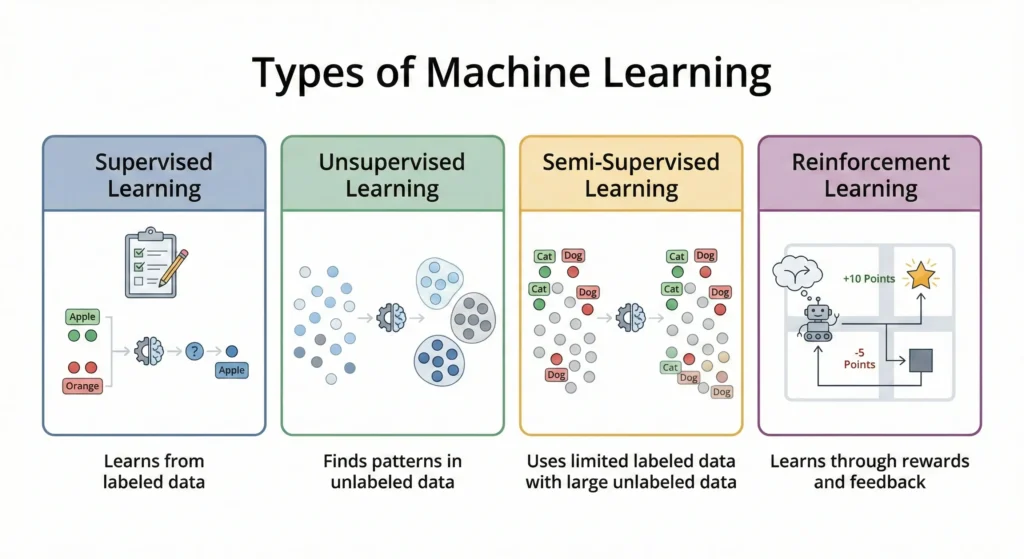
Supervised Learning
Supervised learning means the machine learns with clear answers provided.
The data includes both:
- The input (for example, an email)
- The correct output (spam or not spam)
Over time, the system learns which patterns lead to which answers.
Simple examples:
- Email spam detection
- Image recognition (cat vs dog)
- Predicting house prices
Supervised learning is widely used because it’s reliable when labeled data is available.
Unsupervised Learning
Unsupervised learning means the machine learns without being told the answers.
The system receives data and looks for patterns on its own. No labels, no instructions about what to find.
Simple examples:
- Grouping customers by behavior
- Finding unusual activity in transactions
- Discovering topics in large sets of documents
This approach is useful when you don’t know what patterns exist in advance.
Semi-Supervised Learning
Semi-supervised learning is a mix of both approaches.
The machine learns from:
- A small amount of labeled data
- A large amount of unlabeled data
This is common in real-world situations where labeling data is expensive or time-consuming.
Simple example:
- A few images are labeled “cat” or “dog”
- Thousands of images are unlabeled
- The system uses the labeled examples to understand the rest
Reinforcement Learning
Reinforcement learning works through trial and error.
The machine:
- Takes an action
- Receives a reward or penalty
- Learns which actions lead to better results
Over time, it learns the best strategy.
Simple examples:
- Game-playing systems
- Robotics movement
- Recommendation systems that improve with user feedback
This type of learning is especially useful in dynamic environments.
Real-Life Examples of Machine Learning
Machine learning is already part of everyday technology, even if it’s invisible.
Some common examples include:
- Spam filters in email
- Product recommendations on shopping sites
- Video and music suggestions
- Voice assistants understanding speech
- Navigation apps predicting traffic
- Fraud detection in banking
In all these cases, systems learn from large amounts of past data to make better decisions in the present.
Machine Learning vs Artificial Intelligence
These terms are often used interchangeably, but they are not the same.
- Artificial Intelligence (AI) is the broad idea of machines performing intelligent tasks.
- Machine Learning is one way to build AI systems by learning from data.
A simple hierarchy:
- Artificial Intelligence (big concept)
- Machine Learning (learning from data)
- Deep Learning (learning with large neural networks)
- Machine Learning (learning from data)
Machine learning is a core part of modern AI, but not all AI systems rely on machine learning.
What Machine Learning Is Not
There are a few common misunderstandings worth clearing up.
- Machine learning is not magic
- It does not truly “think” like humans
- It does not automatically understand context
- It can make mistakes
- It depends heavily on data quality
A machine learning system only knows what it has learned from data—and nothing more.
Benefits and Limitations of Machine Learning
Benefits
- Can process huge amounts of data
- Improves over time with more data
- Automates complex decisions
- Finds patterns humans might miss
Limitations
- Requires high-quality data
- Can reflect bias present in data
- Can be difficult to explain
- Expensive to build and maintain at scale
Understanding both sides helps set realistic expectations.
Who Uses Machine Learning Today?
Machine learning is not limited to researchers or engineers.
It’s used by:
- Businesses analyzing customer behavior
- Developers building intelligent applications
- Data analysts working with large datasets
- Product teams improving user experience
- Marketers optimizing campaigns
- Students learning modern technology
Even non-technical roles benefit from understanding the basics.
When Should You Learn Machine Learning?
You should consider learning machine learning concepts if:
- You’re curious about how modern technology works
- You work with data or digital products
- You want future-relevant skills
- You want to understand AI beyond headlines
You don’t need to code to understand machine learning fundamentals.
A Simple Beginner Learning Path
If you’re just starting:
- Understand what machine learning is (this article)
- Learn the different types of machine learning
- Explore real-world use cases
- Experiment with simple tools or examples
Learning step by step makes the topic much less intimidating.
Final Thoughts
Machine learning is not just a technical trend—it’s a foundational technology shaping modern software, products, and services. Understanding its basics helps you make sense of how today’s digital systems work and prepares you for a future where data-driven intelligence is everywhere.
If you want to go deeper, the next step is to explore each type of machine learning in detail, starting with supervised learning and moving forward from there.
Frequently Asked Questions
Machine learning is when computers learn from examples instead of being told exact rules.
The basics are easy to understand. Advanced topics require more effort, but anyone can start.
No. Coding is needed to build models, but not to understand how they work.
AI is the big idea. Machine learning is one method used to create AI systems.
Email, streaming platforms, navigation apps, shopping sites, and banking systems all use it.
Comments