
If you’ve tracked the AI landscape over the last four months, you’ve likely heard the name “Nano Banana.” What started as a funny internal codename that leaked onto public leaderboards in August has become Google’s official branding for their powerhouse image generation models.
But the memes have given way to serious utility.
Today, we are deep-diving into the recent release of Nano Banana Pro (officially powered by the Gemini 3 Pro Image model). We’ve been testing the subscription tier to answer one critical question: Is this just a faster model, or is it a fundamentally different tool for professional workflows?
Here is our detailed review and a practical use case demonstrating why the “Pro” label actually matters.
The Paradigm Shift: “Flash” vs. “Pro”
To understand the value of Nano Banana Pro, we have to look at what came before it.
The original release in August 2025 (retroactively called Nano Banana Flash, or Gemini 2.5) was impressive but chaotic. It was like a talented artist who wouldn’t follow instructions. You asked for specific text, and you got alien hieroglyphs. You asked for the “same character in a new scene,” and you got a vaguely similar cousin.
Nano Banana Pro (Gemini 3 Pro) is built differently. It incorporates DeepMind’s advances in “reasoning” and world knowledge directly into the image generation process.
Here is the breakdown of the critical differences:
| Feature | Nano Banana Flash (The Previous Version) | Nano Banana Pro (The Subscription Version) |
| Text Rendering | The biggest weakness. Text was usually garbled, misspelled, or nonsensical “AI soup.” | Game Changer. It can render legible, accurate text for logos, diagrams, posters, and speech bubbles. |
| Character Consistency | A slot machine. You might get the same person twice, but usually, features, hair, and clothing would morph randomly between generations. | Reliable Actor. Using reference inputs, it maintains uncanny facial, structural, and stylistic consistency across totally different scenes. |
| World Logic | Dream logic. Hands might melt into keyboards; physics were suggestions rather than rules. | Grounded Reality. Because it taps into Google’s Knowledge Graph, it understands how objects actually work. A 2025 server rack looks correct; it doesn’t look like a 1960s sci-fi movie prop. |
| Prompt Adherence | Good at the “vibe,” bad at specifics. Often ignored complex spatial instructions (e.g., “put the red ball to the left of the blue box”). | High Fidelity. It understands complex, multi-clause instructions and spatial relationships much better. |
The Use Case: Creating Consistent Visual Storytelling
A major challenge with AI imagery isn’t generating one cool image; it’s generating a set of images that look like they belong together. Whether for a presentation deck, a website landing page, or a documentation series, visual continuity is critical.
The previous “Flash” model struggled with this continuity. The “Pro” model excels at it.
The Scenario: We are creating a three-part visual series titled: “The 2026 Guide to Migrating Legacy Ops to the Cloud.”
The Goal: We need three distinct images that feature the same visual metaphor and character, evolving through the journey.
Step 1: Establishing the “Hero” Asset (The Anchor)
With the Nano Banana Pro subscription, we aren’t prompting blindly. We can feed it reference data. First, we generate our “protagonist” and the visual style.
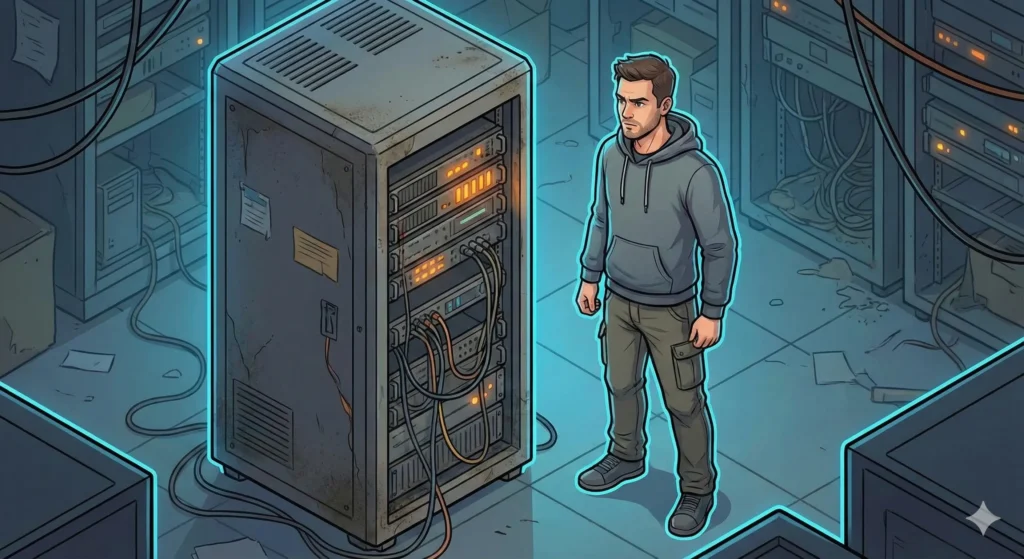
Prompt 1 (Defining the Style): “A stylized illustration, isometric view, digital art style with glowing blue and orange accents. A determined IT specialist, mid-30s, wearing a hoodie and cargo pants, standing next to a bulky, dusty, old-fashioned on-premise server rack with tangled wires. The style should be clean but detailed.”
Result: We get a high-quality image. Let’s call the character “Sam.” We save this image. This is now our anchor.
Step 2: Image #1 – The Struggle (The Legacy System)
Now, for the first section of our content. We need to show the difficulty of the old technology.
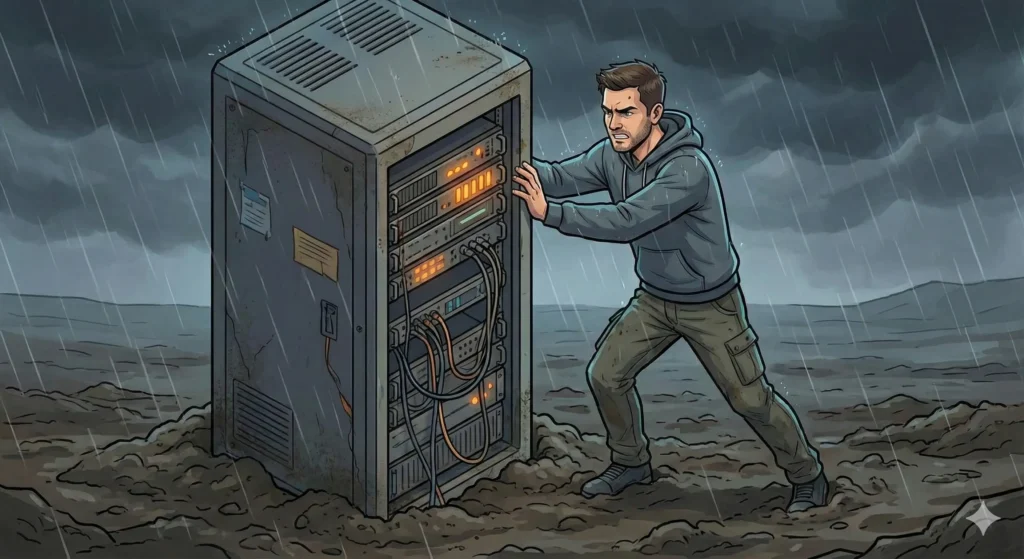
Prompt 2 (Using Reference): “[Reference Image: Sam]. The same character from the reference image is looking frustrated, pushing with all their might against the bulky on-premise server rack, which is stuck in mud. Dark, cloudy atmosphere. Digital art style.”
The Pro Difference: Nano Banana Flash would have likely generated a new person in a hoodie. Nano Banana Pro recognizes Sam’s face, the specific hoodie texture, and the specific design of the server rack from the reference image, simply placing them in a new context.
Step 3: Image #2 – The Migration (The Journey)
Next, we need to illustrate the transition phase. This is where we test the model’s “world logic.”
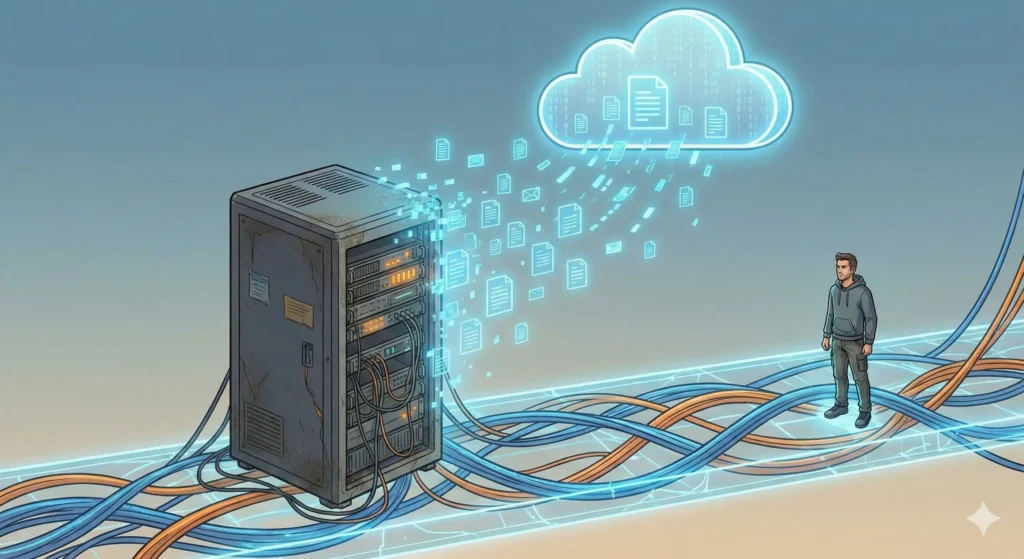
Prompt 3 (Complex Action & Logic): “[Reference Image: Sam]. The same character is standing on a glowing data-bridge made of fiber optic cables, watching the old server rack dissolve into data packets that are floating up toward a stylized, glowing cloud icon in the sky. Hopeful atmosphere.”
The Pro Difference: The model understands the abstract concepts of a “data bridge” and “dissolving into packets” while keeping the character consistent. It manages the complex spatial relationship between the ground, the bridge, and the cloud without hallucinatory artifacts.
Step 4: Image #3 – The Destination (The Infographic Header)
For the final image, we need a “success state” visual that also includes text. This requires the killer feature: Text Rendering.
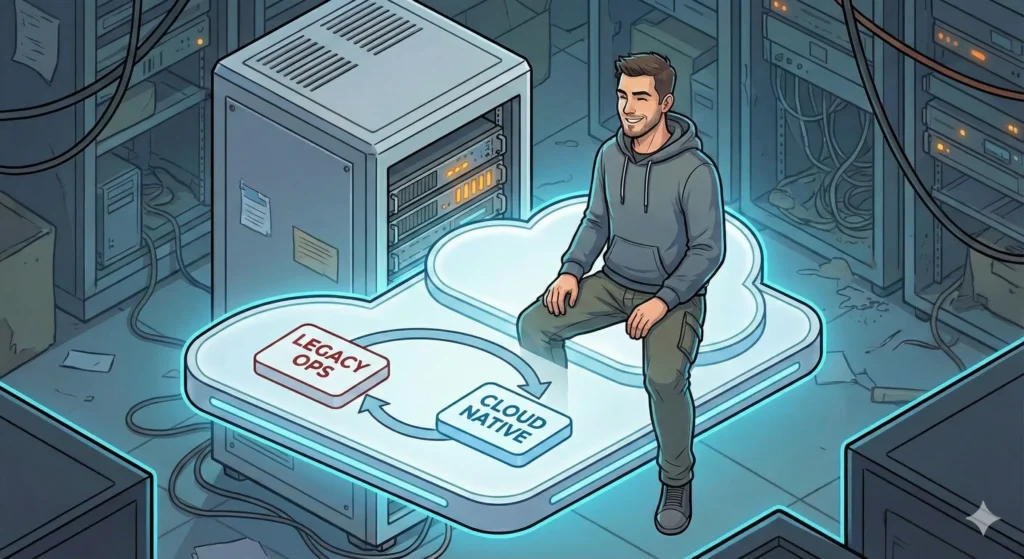
Prompt 4 (Text & Consistency): “[Reference Image: Sam]. The same character is smiling, sitting peacefully on a sleek, modern, glowing cloud platform. Below them, a clean diagram shows two boxes connected by an arrow. The left box is labeled ‘LEGACY OPS’ in red text. The right box is labeled ‘CLOUD NATIVE’ in blue text. The overall style is clean digital illustration.”
The Pro Difference: This prompt would have been impossible four months ago. Nano Banana Pro renders the text “LEGACY OPS” and “CLOUD NATIVE” perfectly legibly within the image’s art style, saving the need for post-production in Photoshop or Canva.
The Verdict
If the goal is simply generating abstract art or chaotic memes, the free “Flash” tier of Nano Banana is sufficient.
However, for a professional content workflow, the Nano Banana Pro subscription has become essential infrastructure. The ability to maintain visual consistency across a series of assets and the newfound capability to render accurate text means less time rerolling prompts hoping for a lucky strike, and more time executing specific creative visions.
It has successfully moved from a “toy” to a “production tool.”
Comments
Solid review. Nano Banana Pro’s improvements in text rendering, character consistency, and prompt adherence make it a clear step up for professional use cases. The comparison to the free version highlights why the upgrade could be worthwhile. Thanks for the detailed analysis.