
In today’s rapidly changing world, organizations face unprecedented disruptions—from cybersecurity breaches and infrastructure failures to supply chain disruptions and natural disasters. The resilience lifecycle framework provides a structured, evidence-based approach to building organizational strength by guiding teams through five critical, interconnected stages. Unlike reactive crisis management, the resilience lifecycle framework transforms uncertainty into opportunity by embedding resilience into every aspect of organizational planning and operations.
Understanding and implementing this framework is essential for modern leaders seeking to protect business continuity, safeguard stakeholders, and emerge stronger from disruption.
What Is the Resilience Lifecycle Framework?
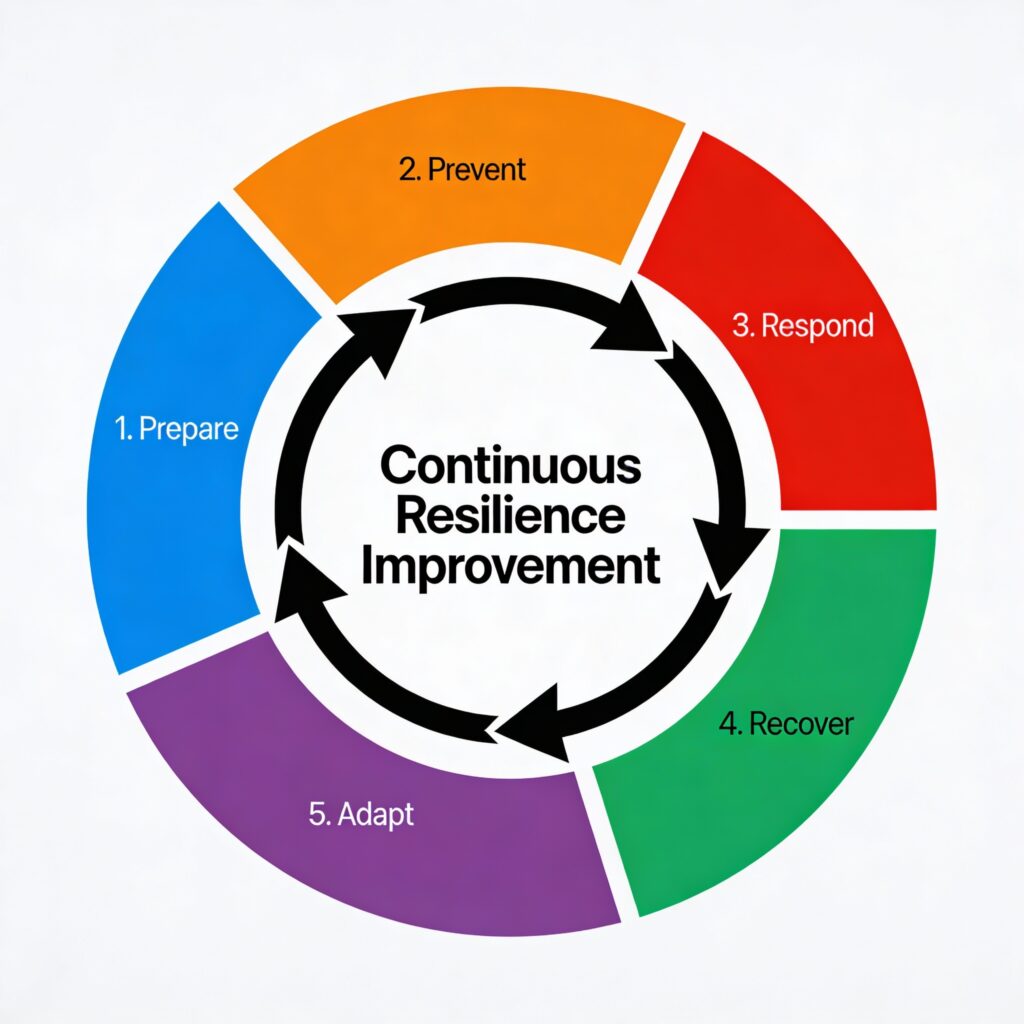
The resilience lifecycle framework is a comprehensive, cyclical model that helps organizations anticipate, prepare for, respond to, recover from, and learn from disruptive events. Rather than treating resilience as a one-time initiative, the framework recognizes that building true resilience is an ongoing process—a continuous loop of planning, prevention, response, recovery, and adaptation.
The framework addresses a fundamental challenge in modern enterprises: most organizations invest heavily in crisis response but neglect the preparation and learning phases. The resilience lifecycle framework flips this priority, emphasizing proactive preparation and continuous improvement. Each stage feeds into the next, creating momentum that strengthens the organization’s ability to withstand and recover from future disruptions.
At its core, the framework operates on three key principles: awareness (identifying emerging risks through monitoring), adaptability (adjusting strategies under pressure), and learning (integrating feedback into future planning). Together, these principles form the foundation for sustainable organizational resilience.
Stage 1 – Prepare (or Anticipate)
The Prepare stage is the foundation of organizational resilience. It’s where leaders proactively assess vulnerabilities, identify critical business functions, and develop strategies before disruption occurs. Without thorough preparation, organizations default to reactive crisis management, scrambling to respond when disruption strikes.
During preparation, organizations must honestly evaluate their risk landscape. What threats could disrupt operations? Which business processes are most critical? What resources and capabilities are needed to maintain continuity? These questions drive comprehensive risk assessments and business impact analyses.
Key Activities in the Prepare Stage
- Risk Assessment and Threat Modeling: Identify internal and external threats (cybersecurity vulnerabilities, infrastructure failures, supply chain dependencies, regulatory changes, natural disasters, personnel risks)
- Business Impact Analysis (BIA): Determine which business processes are mission-critical and define Recovery Time Objectives (RTO) and Recovery Point Objectives (RPO) for each process
- Capacity and Resource Planning: Assess current capabilities, identify resource gaps, and plan for redundancy in critical systems and processes
- Contingency Planning: Develop detailed action plans, communication protocols, and decision trees for various disruption scenarios
- Team Training and Awareness: Conduct tabletop exercises, emergency drills, and awareness programs to ensure teams understand their roles and responsibilities during crises
- Documentation: Create and maintain comprehensive business continuity plans, disaster recovery procedures, and contact lists for all critical stakeholders
Stage 2 – Prevent (or Protect)
The Prevent stage focuses on reducing the likelihood and severity of potential disruptions. While complete prevention is impossible, proactive measures significantly minimize exposure to risk. Organizations that excel in prevention reduce crisis frequency and impact, allowing teams to focus on growth rather than crisis management.
Prevention differs from preparation: preparation assumes disruptions will occur; prevention aims to stop them from occurring. This might involve strengthening cybersecurity defenses, diversifying suppliers, implementing quality controls, or upgrading aging infrastructure.
Key Activities in the Prevent Stage
- Security Hardening: Strengthen cybersecurity posture (patch management, access controls, encryption, threat detection, incident response automation)
- Infrastructure Improvements: Upgrade critical systems, implement redundancy, and modernize legacy infrastructure to reduce failure risk
- Supplier and Vendor Diversification: Reduce dependency on single suppliers; establish relationships with alternative vendors and backup service providers
- Predictive Monitoring: Deploy analytics and monitoring tools to detect early warning signs of system failures, security threats, or operational anomalies
- Policy and Compliance Updates: Establish and enforce security policies, compliance standards, and operational procedures that reduce risk exposure
- Environmental and Physical Security: Implement protections against physical threats, natural disasters, and facility-level risks
Stage 3 – Respond
The Respond stage activates when disruption occurs despite preparation and prevention efforts. Effective response focuses on immediate damage limitation, protecting people and assets, maintaining critical functions, and managing communications to stakeholders.
Response success depends on preparation—teams that trained during the prepare stage respond faster and more effectively. Response should be decisive, coordinated, and transparent. Unclear communication and delayed action during crisis amplifies disruption impact and damages organizational trust.
Key Activities in the Respond Stage
- Incident Activation: Trigger incident response plans, activate crisis response teams, establish a command structure, and convene decision-makers
- Situational Assessment: Gather real-time information about incident scope, impact, and trajectory; assess ongoing risks and threats
- Communication Management: Establish clear, timely communication with employees, customers, regulators, and media to manage expectations and prevent misinformation
- Critical Function Stabilization: Activate backup systems, redirect work to unaffected facilities, and implement contingency procedures for critical business functions
- Resource Mobilization: Allocate personnel, budget, and equipment to address immediate impacts and prevent situation escalation
- Coordination with External Partners: Engage emergency responders, government agencies, vendors, and insurance providers as needed
Stage 4 – Recover
The Recover stage focuses on restoration—returning business functions to operational status and rebuilding systems and infrastructure. However, recovery is more than simply restoring pre-disruption conditions. Effective recovery includes analyzing what failed, capturing lessons, and building back better—stronger and more resilient than before.
Recovery involves both technical restoration and human restoration. Employees experience trauma during crises; supporting their well-being during recovery builds organizational trust and loyalty. Customers and stakeholders also need reassurance; transparent communication about recovery progress strengthens relationships.
Key Activities in the Recover Stage
- Damage Assessment: Evaluate the extent of operational, financial, reputational, and human impact across the organization
- Recovery Prioritization: Sequence recovery activities based on business criticality, dependencies, and resource availability
- System and Infrastructure Restoration: Rebuild or replace damaged systems, restore data from backups, test systems before returning to production
- Workforce Support: Provide psychological support, clear communication, and guidance to employees affected by the disruption
- Customer and Stakeholder Communication: Update customers about service restoration, explain impact management, and provide timeline expectations
- Root Cause Analysis: Conduct post-incident reviews to understand what failed, why systems didn’t function as designed, and what can be improved
Stage 5 – Adapt (Learn and Improve)
The Adapt stage is where true resilience matures. This is the critical, often-overlooked phase where organizations transform crisis experience into institutional knowledge. Organizations that excel at adaptation systematically extract lessons from disruptions and embed improvements into systems, processes, and culture.
Adaptation transforms reactive thinking into proactive strategy. Instead of repeating past mistakes, organizations evolve their capabilities, update strategies, and build stronger foundations for future disruptions.
Key Activities in the Adapt Stage
- Lessons Learned Analysis: Conduct comprehensive reviews of response and recovery effectiveness, identifying what worked, what didn’t, and why
- Process and Procedure Updates: Refine business continuity plans, incident response procedures, and contingency strategies based on actual performance during disruption
- Technology and Infrastructure Improvements: Invest in systems upgrades, automation, and capabilities revealed as gaps or weaknesses during the disruption
- Training Program Enhancements: Update training and awareness programs to address lessons learned; share insights across the organization and industry
- Cultural Evolution: Embed resilience thinking into organizational culture, decision-making, and strategic planning
- Capability Assessment: Evaluate resilience maturity using frameworks and benchmarks, identifying priority areas for ongoing improvement
How the Resilience Lifecycle Framework Works as a Continuous Loop
The resilience lifecycle framework is fundamentally cyclical, not linear. After completing the Adapt stage, organizations return to the Prepare stage with enhanced knowledge and capabilities. Insights from past disruptions inform more robust risk assessments, more sophisticated prevention strategies, and more effective response planning.
This continuous cycle prevents the common mistake of treating disruption as a rare event. Instead, the framework embeds resilience as a core operational discipline—something practiced daily, not just during crises. Teams that continuously cycle through these stages develop organizational muscle memory, enabling faster, more effective responses when real disruptions occur.
The feedback loop is critical: adaptation insights directly improve preparation activities. Organizations that skip or rush the adapt stage lose institutional memory, repeating past mistakes and failing to strengthen resilience over time.
Why the Resilience Lifecycle Framework Matters
Business Continuity: Organizations following the resilience lifecycle framework maintain critical functions during disruptions, meeting customer expectations and protecting revenue streams. Those without formal resilience frameworks experience extended downtime, financial losses, and customer defection.
IT and Cloud Resilience: Modern IT operations depend on resilience—infrastructure failures, ransomware attacks, and cloud provider outages are inevitable. The framework enables IT teams to design redundancy, implement rapid response protocols, and learn continuously from incidents.
Cybersecurity Readiness: Breaches and attacks will occur despite security investments. The framework helps organizations minimize breach impact through rapid detection (Prevent), swift containment (Respond), effective recovery (Recover), and systemic improvements (Adapt).
Operational Stability: Beyond crisis response, the framework promotes operational excellence by identifying risks proactively, implementing preventive measures, and continuously improving processes. This drives efficiency, quality, and reliability in day-to-day operations.
Real-World Applications of the Resilience Lifecycle Framework
Enterprise IT Operations: Organizations leverage the framework to design disaster recovery strategies, plan for infrastructure failures, implement backup systems, and manage incidents when systems fail. The continuous cycle ensures recovery capabilities remain current and effective.
Cloud Infrastructure Management: Cloud platforms enable agility but require resilience discipline. Teams use the framework to design multi-region deployments (Prepare), implement security controls (Prevent), activate failover during outages (Respond), restore from backups (Recover), and update configurations based on incident analysis (Adapt).
Cybersecurity Programs: Security teams use the framework to conduct risk assessments and penetration testing (Prepare), harden systems and patch vulnerabilities (Prevent), coordinate breach response (Respond), restore systems from clean backups (Recover), and implement controls addressing root causes (Adapt).
Supply Chain Resilience: Organizations identify supplier dependencies (Prepare), diversify suppliers and establish backup sources (Prevent), activate alternative suppliers during disruptions (Respond), rebuild supplier relationships (Recover), and restructure supply chains for greater flexibility (Adapt).
Conclusion
The resilience lifecycle framework provides the structured approach modern organizations need to navigate uncertainty and build sustainable strength. By moving through its five stages—Prepare, Prevent, Respond, Recover, and Adapt—organizations transform disruption from a threat into an opportunity for growth and competitive advantage.
Resilience isn’t built through one-time initiatives or crisis response playbooks. It’s built through continuous cycling through the framework, embedding learning into culture, and treating preparedness as an ongoing discipline. Organizations committed to this continuous improvement mindset emerge from disruptions stronger, more adaptable, and better positioned for long-term success.
The question isn’t whether your organization will face disruption—it’s whether you’ll be prepared, and whether you’ll learn and improve when disruption occurs. The resilience lifecycle framework provides the roadmap.
FAQs
The resilience lifecycle framework is a continuous, five-stage cycle (Prepare, Prevent, Respond, Recover, Adapt) that helps organizations proactively build strength to withstand and recover from disruptions. Rather than treating crises as rare events, the framework embeds resilience into ongoing operations, creating a discipline of continuous preparation and learning.
The five stages are: (1) Prepare—conduct risk assessments and develop contingency plans; (2) Prevent—reduce likelihood and severity of disruptions; (3) Respond—activate response during active crisis; (4) Recover—restore operations and systems; (5) Adapt—learn from experience and improve strategies. The resilience lifecycle framework cycles continuously through these stages.
By systematically preparing, preventing, responding, and learning, organizations minimize disruption impact and recovery time. The resilience lifecycle framework ensures critical functions remain operational during crises, communication reaches stakeholders, and systems recover quickly—all essential to maintaining business continuity.
Yes, extensively. IT and cloud teams use the framework to design disaster recovery strategies, implement redundancy, plan for infrastructure failures, and manage cyber incidents. The resilience lifecycle framework ensures cloud deployments remain available despite failures or attacks.
Organizations should continuously cycle through the framework. Preparation and prevention activities happen daily; response occurs as incidents arise; recovery is ongoing during disruption; adaptation happens post-incident. The resilience lifecycle framework is an ongoing discipline, not an annual review—though formal assessments should occur at least annually or when organizational changes occur.
Traditional disaster recovery focuses primarily on recovery (restoring systems and data). The resilience lifecycle framework encompasses the complete lifecycle—preparation, prevention, response, recovery, and learning. This holistic approach builds sustainable resilience rather than simply reacting to crises, making it more effective for modern organizations.
Comments